Es plätschert der Bach

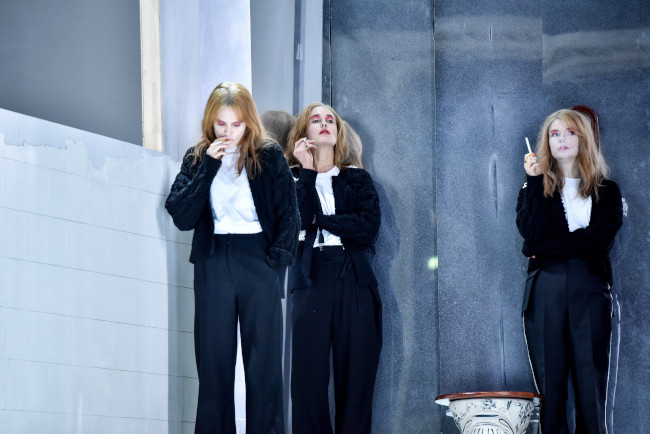
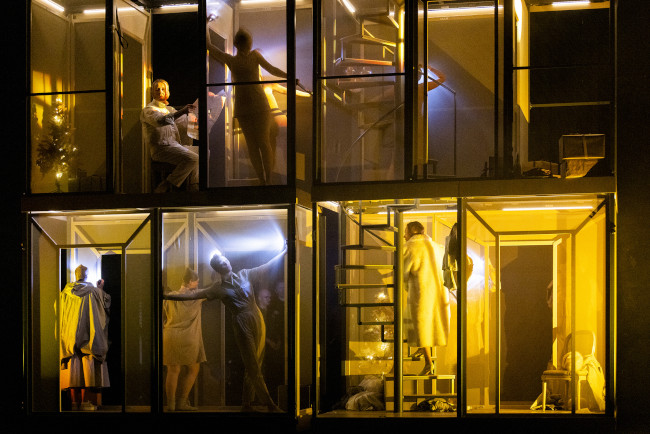
Das wohltemperierte Klavier, Musiktheater nach Johann Sebastian Bach unter Verwendung des Romans »Melancholie des Widerstands« von László Krasznahorkai, Schaubühne am Lehniner Platz, Berlin (Regie: David Marton)

Das kann auch nur einem Pianisten einfallen: Bachs “Wohltemperiertes Klavier”, dieser Durchgang durch alle dem Klavier möglichen Dur- und Moll-Tonarten, dieses Mammutwerk musikalischer Ordnung, als Grundlage für einen Theaterabend zu wählen. David Marton ist seit jeher ein Grenzgänger zwischen Sprech- und Musiktheater, der beide einander aufladen, hinterfragen, aufeinander prallen lässt und in der Kollision eine eigene Theatersprache findet. Um es vorwegzunehmen: Dies gelingt ihm an diesem Abend nicht. Zu sehr stehen Musik- und Sprechtheater nebeneinander, zu sehr fällt auch Letzteres gegenüber Ersterem ab. Die Symbiose gelingt genauso wenig wie der Konflikt, stattdessen stehen beide weitgehend unabhängig nebeneinander. Die Auseinandersetzung mit Bachs Werk und dem, wofür es steht, ist überaus spannend, ein gelungener Theaterabend ensteht daraus jedoch nicht.

Das Wohltemperierte Klavier

Foto: Thomas Aurin

Continue reading

Berlinale 2012: Diary Day 11

It’s done: the 62nd Berlinale is history. The awards have been given out, the festival can enter the history books. The Taviani brothers have won the Golden Bear for Cesare deve morire, while the big favourite, Bence Fliegauf’s Csak a szél received the Special Jury Prize, other Silver Bears went to L’enfant d’en haut, Christian Petzold’s Barbara (direction), Rebelle and En Kongelig Affaere (actors). All worthy winners although one can feel a little disappointment that the best and most important film of the festival, Bence Fliegauf’s moving, haunting, radical Csak a szél did not win the big one. For a decidedly political festival that is also committed to new esthetics, younger film makers and regional diversity, this would have been a perfect choice and an important signal that human rights and democracy must be guarded wherever they are under attack – particularly in the heart if Europe. You can find all awards at www.berlinale.de.

Continue reading

Berlinale 2012: Diary Day10

Magyarorszag 2011 (Berlinale Shorts / Hungary / Director: various)

Since Viktor Orbán’s right-wing government took power in 2010, its main objective has been to curb democratic and human rights in Hungary. Especially the press and the arts have been under increasing threat. Magyarorszag 2011, produced by last year’s Silver Bear winner Béla Tarr, is a testament to the resistance of some of Hungary’ leading film makers who refuse to give up their artistic freedom and want to show that the art of film making is still alive in Hungary even though the film industry has been effectively stopped. In eleven episodes eleven directors present their views of the current situation in their country as well as the versatility and the diversity of Hungarian film making. The subjects range from social issues such as poverty and homelessless to film making itself and the possibility of free speech. Styles vary, too: There is the black and white of András Jeles and Simon Szabó, the documentary camera of Ferenc Török and Bence Fliegauf, Jeles and Andras Salamon show faces in close-up. Some episodes stand out: one is Péter Forgács’ satirical and poetical essay on politics, another Fliegauf’s film in which he just keeps the camera focused: on a rundown house, a swimming pool, faces in a children’s home. Török combines impressions of the recently renamed former Moscow Square in Budapest with a speech by Orbán while László Siroki contrasts the richness of Budapest with the poverty of a Roma village – using animal sounds as the backdrop for the urban scenery and street noise for the rural. The most poignant statement on the threat of silencing a country’s culture belongs to György Pálfi: He shows elaborate opening and closing credits – and empty, scratched celluloid in-between.

Continue reading

Berlinale 2012: Diary Day 9

Cherry (Panorama / USA / Director: Stephen Elliott)

Somewhere there must be a factory turning out scripts lile this on an industrial basis: a beautiful young woman, an alcoholic mother, a selfish boyfriend and a best friend who is secretly in love with her. She goes away, ends up in the porn industry, meets the dream man who turns out not to be so great after all. So far so bad and seen many many times. Everyone is fairly beautiful, everyone disagrees with the porn job, providing points of conflict and food for plot twists throughout. Again and again we see her alone, crying, suffering, the usual fast edited shots of a face in turmoil. Esthetically the film is as uninteresting as its story, both being pure routine. However, there are two at least partly redeeming features: First a novel look at the porn industry. There is nothing sleazy about this here, all are friendly and highly professional, the atmosphere and look is that of a high quality advertising agency. The second aspect is the ending: director Stephen Elliott refuses resolutions, none of the open issues are closed, and there is no turning away from her job. This is her life and she calls the shots. The last five minutes of the film are more interesting and honest than the entire rest of the film.

Continue reading

Berlinale 2012: Diary Day 8

My Brother the Devil (Panorama / UK / Director: Sally El Hosaini)

Rachid and Mo are brothers of Egyptian descent living in London’s troubled Hackney district.  Rachid is the gangster, Mo the good little brother who adores the older one. Of course, he tries to be a gangster, too, while Rachid, prompted by a tragic event, wants to get out. As if that wasn’t enough, director Sally El-Hosaini adds a few more twists to make sure there will be a violent escalation. The ending is, of course, optimistic, everyone has learned their lessons and, of course, crime doesn’t pay. Everything about this story is cliché, many dialogues copied straight from the textbook, some plot twists bordering on the ridiculous. Added to this is a well-tested style for films of this subject matter, complete with fast editing and swelling sound whenever something dramatic is about to happen. Inner turmoil is represented by fragmented images, hip hop music is never far (one of the brothers writes rap songs, of course). What keeps this thoroughly uninspired and conventional film a little interesting, at least for a while, are the two actors who lend their roles the credibility and plausibility their director largely denies her film.

Continue reading

Berlinale 2012: Diary Day 7

Die Vermissten (Perspective German Cinema / Germany / Director: Jan Speckenbach)

A teenage girl disappears. Her father who has not seen her in seven years goes searching for her. This made for TV film starts out as a family drama albeit a rather cool, bloodless one. It is shot in the pointedly realistic way that has become the style of choice in contemporary German cinema. It is a decidedly gray world, everything screams decay. Halfway through the film takes a turn into the (pre? post?) apocalyptic but the film never takes off or rather it never wakes up. There is no intensity of any sort, the contrast between the story and the realistic style fails to create any atmosphere and the dialogues are embarrassingly formulaic. There is no direction, it seems like someone had what seemed to be a good idea but nobody knew what to do with it. An utterly forgettable film.

Continue reading

Berlinale 2012: Diary Day 6

Dollhouse (Panorama / Rep. of Ireland / Director: Kirsten Sheridan)

If there was a construction kit for films about disturbed teenagers, Dollhouse would be built from it. Pick a few teenagers, preferably from the lower social spheres, get an aggressive boy and an upperclass girl, give them an empty house, throw in alcohol and drugs, Add a big secret or two, finally some hip music and stir. And outcomes a film like Dollhouse, a wild housewrecking party with its fair share of stereotypically hallucinatory scenes a big surprise near the end and a long drawn-out ending that totally destroys the tone if the film. Dollhouse is entertaining at times, has one great sequence as one of the rooms get devorated by putting all furniture upside down. Nothing in Dollhouse is upside down though, this is a routine movie with nothing of its own. In Disco Pigs, her directorial debut, Kirsten Sheridan demonstrated how to portrait teenage angst in a creative, truly original, visually fascinating and intellectually challenging way. Dollhouse is none of these things.

Continue reading

Berlinale 2012: Diary Day 5

This Ain’t California (Perspective Germany Cinema/ Germany / Director: Marten Persiel)

Denis is dead. Aged 41, he died in 2011 while serving with the German army in Afghanistan. Since 1999, he had been a soldier but before that he was the leader, the centerpiece, the inspiration or just the chief jerk of something that should never have existed in the first place: the East German skateboarding scene before the fall of the wall. This Ain’t California is a testament to that forgotten episode of the other German state, a tiny, unimportant one, but the core and backbone of those who were part of it. The film starts out with Denis’ death, bringing together former friends long scattered in many places. They reminisce about their youth and go out in search of Denis, who everyone remembers under his pseudonym: Panik. Building on this reunion and using loads of privately footage, the film, piece by piece, brings this impossible movement to life before our very eyes.  Mixing original footage, the reunion, narration from several of those involved and beautifully drawn animations it recreates a little of this strange miniature universe these kids created for themselves – totally unpolitical but, in its aimless pursuit of fun, its focus on individuality set against everything the East German state was about. The freedom they sought was not ideological – but it was an alternative to the utilitarist doctrine which was at the heart of all of East German life. Everything needed to have a purpose, the collective was everything, the individual nothing. This Ain’t California is funny, entertaining, but also deeply moving. Its distinctive rhythm wonderfully symbolizes the lifestyle these kids made up from scratch. The film allows us to dive into a lost world – and a lost soul: Denis who went further than anyone, Denis who got lost somewhere along the way, Denis who is brought back to life for a moment because what he represented, what he was looking for, what he was living never died. A miracle of a film that makes you laugh and cry and everything in between.

Continue reading

Berlinale 2012: Diary Day 4

Kazoku No Kuni (Forum / Japan / Director: Yang Yonghi)

Yang Yonghi’s first feature film goes back to the topics of her previous documentaries: the story of her family, divided between Japan and their native North Korea. A young man who repatriated to Pyongyang at the age of sixteen is allowed back for medical treatment but the visit is cut short for no apparent reason. For a very short time lives completely separate try and come together only to be torn apart again. A family refinding itself  before falling victim to a faceless irrational Big Brother – the gentle, quiet, unsentimental way this story is told, how voices, mutual languages must be rediscovered is as moving as it is at times almost unbearably painful. The handheld camera lends the film an instability that corresponds well with the state of limbo portrayed. The story is told in short, quiet moments: the father’s deafening speechlessness, the son’s slow shedding of his robot-like facade, the utter incomprehension of the decision to call Sungho back after just one week, the sister’s literal inability to let her brother go. The human is pitted against that unseen power trying to root out individuality and even though it seems to win, these moments tell a different story. The film’s quiet, almost documentary-like realism gives it an intensity that is hard to bear at times – and impossible to forget.

Continue reading

Berlinale 2012: Diary Day 3

Espoir-Voyage (Forum / France, Burkina Faso / Director: Michel K. Zongo)

Burkina Faso film maker Michel K. Zongo sets out to retrace the steps of his older brother who, like so many other young men, left his home country to work in the coffee and cocoa plantations of neighboring Ivory Coast, never came home and is reported to have died. Zongo interviews family and friends before he joins other immigrants on a bus journey across the ragged roads of Ivory Coast, meets other workers and farmers from Burkina Faso and finally finds the place where his brother has lived and died. It is first and foremost a personal journey for Zongo but at the same time it is much more. For in the interviews and the impressions of villages, plantations, fields and houses appear other stories: that of a people whose young generation goes abroad in order to earn their living and support their families, and through this example that of the global issue of immigration. Zongo refuses to paint things in black and white: Some actually do find success and happiness, others are at least better off than former generations who were little more than modern slaves. And then there are those like Zongo’s brother who tried to rip out his roots, burn all bridges and completely assimilate in his new country. There is nothing simple about migration and it is to the film’s merit that it hints at the fact that there are just as many emigration and immigration stories as people who leave their home in search of a better life.

Continue reading

Follow

Get every new post delivered to your Inbox.